

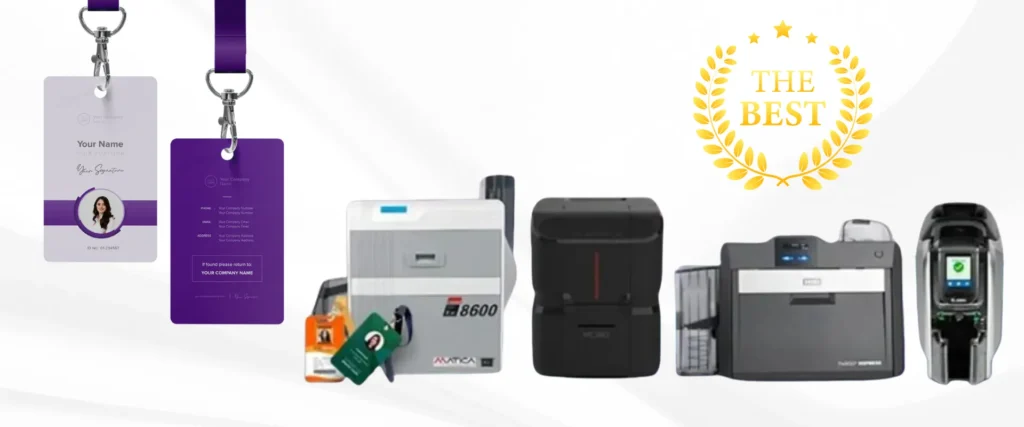
Choosing the right ID card printer in a dynamic market like the UAE can feel overwhelming. You’ve got two main technologies, a dozen different features, and specific security needs that are unique to businesses in Abu Dhabi and Dubai. This guide cuts through the noise. We’ll break down the two primary printing technologies, explain the features that actually matter, and give you a clear framework for making the right choice for your organization.
What Are ID Card Printers and Why Do They Matter in the UAE?
ID card printers aren’t your typical office printers. They’re specialized devices built for one key job: producing professional, personalized identification cards. For any organization in the UAE—from government and corporate to healthcare and education—these cards are your first line of security, access, and identity management.
In a region defined by large workforces, high-security facilities, and ever-expanding smart city infrastructure, the demand for durable, secure, and professional-grade ID cards has never been higher. The market is dominated by two core technologies: direct-to-card (DTC) and retransfer printing. Each one is designed for different operational needs, and understanding the difference is the first step to making a smart investment. For businesses in Abu Dhabi and Dubai, the choice also involves weighing print quality and security against local compliance rules like the Emirates Conformity Assessment System (ECAS).
What’s the Difference Between Direct-to-Card and Retransfer Printing?
The technology inside the printer directly impacts your card’s quality, durability, and cost. Here’s the breakdown.
Direct-to-Card (DTC) printing uses a print head that applies ink directly onto the surface of a plastic card. It’s a fast and economical process, making it a great fit for high-volume jobs where speed is a priority. The one trade-off is that DTC printers almost always leave a tiny, unprinted white border around the very edge of the card. This is perfectly fine for standard employee IDs, but it’s not a true “full-bleed” print.
Retransfer printing is a two-step process that delivers a more premium result. First, the printer prints your card design onto a clear retransfer film. Then, it uses heat and pressure to bond that film onto the card surface. This technique produces a true edge-to-edge print with no white border. More importantly, it encases the printed image under a protective film layer, which dramatically improves the card’s resistance to scratches and fading.
This durability is a huge plus for organizations in the UAE’s hot and humid climate. Retransfer is also the go-to technology for printing on smart cards, access cards with embedded chips, and other non-standard card types, as the flexible film can easily apply to uneven surfaces where a direct print head might fail.
Does High-Resolution Print Quality Really Matter?
Absolutely. Modern ID card printers offer resolutions between 300 and 600 dots per inch (dpi), with retransfer models consistently hitting the higher end of that scale. For UAE card programs, high resolution isn’t just a “nice-to-have”—it’s critical.
Why? Because fine details like Arabic text, intricate company logos, scannable barcodes, and tiny security microtext all require sharp, precise printing to be legible and effective. While a standard 300 dpi DTC printer can handle basic designs, a 600 dpi retransfer printer is the preferred choice when your card design includes complex graphics or security-grade elements.
Modern printers produce high-resolution output for:
- Corporate employee IDs with photos and detailed text
- Government and visitor identification cards
- Access control and building security cards
- University student and faculty cards
- Healthcare staff and patient ID cards
- Membership, loyalty, and guest cards
What Security Features Should I Look For?
The real difference between a basic printer and an enterprise-grade machine lies in security. Advanced printers offer layered security features that protect against both physical card counterfeiting and digital data theft during the printing process.
Physical card security features make it incredibly difficult for someone to duplicate a card. These include:
- Holographic overlays & laminates: Adds a durable, tamper-evident layer that’s hard to replicate.
- UV printing: Prints invisible ink or images on the card that are only visible under a UV light.
- Watermarking: Embeds a subtle, custom image into the card surface.
- Microtext: Prints tiny text that is nearly impossible to read or copy without magnification.
These features are widely used in UAE government, oil and gas, and critical infrastructure sectors where a fake access card poses a significant security threat.
Digital security features protect your cardholder data:
- Data encryption: Scrambles the print data sent from the computer to the printer, preventing interception.
- Host authentication: Creates a digital handshake, ensuring that only authorized computers and software can send print jobs to the printer. This directly prevents rogue employees or attackers from issuing fraudulent cards.
How Do These Printers Connect to an Enterprise Network?
Modern ID card printers come standard with USB and Ethernet connectivity, and some newer models even offer Wi-Fi. For UAE businesses with offices in Abu Dhabi, Dubai, and other emirates, Ethernet is key. It allows you to manage card issuance centrally from one location without needing a dedicated printer attached to a workstation at every single site.
On the software side, most professional printers are compatible with leading card issuance platforms. Two of the most common are:
- HID FARGO Connect: A cloud-based platform that’s perfect for remote management and integrating with other enterprise systems like HR or access control databases via APIs.
- CardPresso: A powerful, user-friendly application for designing and printing cards in an on-premise environment.
Before you buy, always have your IT team verify driver compatibility with your specific version of Windows or macOS. Driver issues are a common but avoidable headache in enterprise deployments.
Who Should Buy an ID Card Printer in Abu Dhabi?
An in-house ID card printer makes sense for any organization that issues credentials in moderate to high volume and needs direct control over the design, security, and issuance process.
DTC printers are the best fit for organizations focused on speed and cost-per-card, such as:
- Companies issuing standard PVC employee or visitor badges.
- Schools or clubs with high-volume membership card needs.
Retransfer printers are the right choice for organizations that require higher security, durability, and compatibility with advanced cards. This includes:
- Government ministries and federal authorities in Abu Dhabi.
- Corporate business parks and free zones with large, diverse workforces.
- Universities and schools issuing multi-function student smart cards.
- Healthcare facilities needing secure staff IDs for patient safety.
- Oil, gas, and industrial sites requiring high-security access cards.
Comparison: Entry-Level DTC vs. Enterprise Retransfer
To make the choice clearer, here’s a head-to-head comparison of the two technologies for a typical UAE deployment.
| Feature | Direct-to-Card (DTC) Printing | Retransfer Printing |
|---|---|---|
| Core Technology | Dye-sublimation printhead applies ink directly onto the card surface. | Prints onto a transparent retransfer film, which is then thermally bonded to the card surface. |
| Print Coverage | Near edge-to-edge printing with a narrow unprinted border. | True full-bleed edge-to-edge printing across the entire card. |
| Typical Resolution | 300 dpi standard; selected models support up to 600 dpi. | Typically 600 dpi or higher for premium print quality. |
| Card Durability | Standard durability because the image remains exposed on the card surface. | Superior durability as the printed image is protected beneath a retransfer film layer. |
| Smart Card Printing | Limited on uneven card surfaces such as embedded chip cards. | Excellent for smart cards, RFID cards and uneven card surfaces. |
| Security Features | Supports UV printing, security overlays and basic anti-counterfeit features. | Supports holographic laminates, UV printing, secure overlays, encryption and advanced card security. |
| Print Speed | Faster due to its simple single-pass printing process. | Slower because the image is first printed on film before being transferred to the card. |
| Cost Per Card | Lower operating cost with affordable ribbons and consumables. | Higher operating cost because both ribbons and retransfer film are required. |
| Best For | Employee ID cards, visitor badges, membership cards and other high-volume card printing applications. | Government IDs, banking cards, smart cards, corporate security badges and premium identification programs. |
| Connectivity | USB and Ethernet | USB, Ethernet and Wi-Fi (available on selected printer models) |
Simply put, DTC is the workhorse for fast, affordable, standard ID badging. Retransfer is the specialist for premium, high-security, and technologically advanced cards.
Choose Direct-to-Card (DTC) if…
- Your program focuses on high-volume standard PVC badges.
- Print speed and a low cost-per-card are your main priorities.
- Your cards don’t use smart chip or contactless technology.
Choose Retransfer Printing if…
- Your cards include contactless, smart chip, or composite materials.
- You need flawless edge-to-edge printing and maximum durability.
- Advanced security like holographic overlays and data encryption are mandatory.