
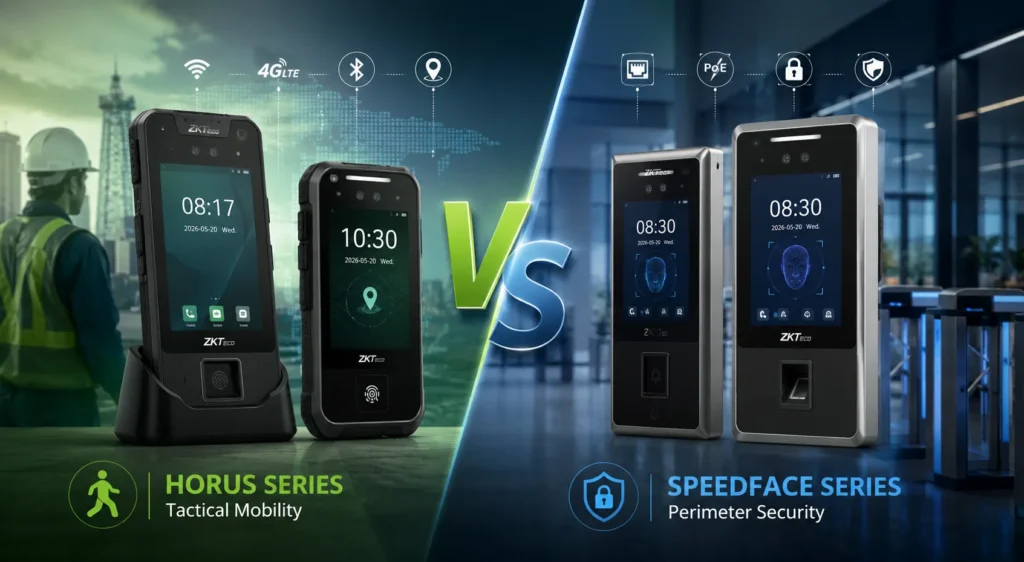
If you’re planning to invest in a ZKTeco biometric solution, you’ll quickly notice that the Horus and SpeedFace series are among the most popular options. Although both support facial recognition, fingerprint authentication (on selected models), and attendance management, they are designed for completely different working environments. Understanding these differences will help you choose a device that matches your business instead of paying for features you may never use.
What is the Difference Between Horus and SpeedFace?
Horus vs SpeedFace: Side-by-Side Comparison
The table below provides a side-by-side comparison of the ZKTeco Horus and SpeedFace series, covering the maximum available features and specifications across their latest models. Use it to quickly identify which series best fits your attendance and access control requirements.
| Feature | ZKTeco Horus Series (Latest Models) | ZKTeco SpeedFace Series (Latest Models) |
|---|---|---|
| Primary Purpose | Mobile Time Attendance & Remote Workforce | Fixed Time Attendance & Access Control |
| Recommended Deployment | Construction, Logistics, Field Staff, Facility Management | Offices, Factories, Schools, Hospitals, Warehouses |
| Maximum User Capacity | Up to 50,000 Users | Up to 50,000 Users (Latest Enterprise Models) |
| Maximum Face Capacity | Up to 20,000 Face Templates | Up to 50,000 Face Templates (Model Dependent) |
| Maximum Fingerprint Capacity | Up to 30,000 Fingerprints (FP Models) | Up to 50,000 Fingerprints (Selected Models) |
| RFID Card Capacity | Up to 50,000 Cards | Up to 50,000 Cards |
| Attendance Logs / Transactions | Up to 200,000 Logs | Up to 1,000,000 Logs (Latest Enterprise Models) |
| Authentication Methods |
Face Card Password Fingerprint* QR Code* |
Face Fingerprint* Palm* Card Password QR Code* |
| Recognition Speed | < 1 Second | < 1 Second |
| Recognition Distance | 0.3–1.0 m | Up to 3 m (Selected Models) |
| GPS | ✔ Available on Selected Models | ✖ No |
| 4G LTE | ✔ Yes | ✖ No |
| Built-in Battery | ✔ Available on Selected Models | ✖ No |
| Wi-Fi | ✔ Yes | ✔ Yes (Selected Models) |
| Ethernet (TCP/IP) | ✔ Yes | ✔ Yes |
| Door Access Control | Basic to Standard | Advanced |
| Turnstile Integration | Limited | ✔ Fully Supported |
| Operating System | Android 10 | Embedded Linux |
| Best Choice For | Businesses with Mobile Employees | Businesses Requiring Secure Building Access |
The Core Concept: Tactical Mobility vs. Perimeter Security
To understand these product lines: Horus vs SpeedFace, look at their structural design philosophy:
- The Horus Ecosystem represents Tactical Mobility. It is an Android-native, highly portable hybrid biometric client designed for dynamic, decentralized environments where infrastructure is unpredictable.
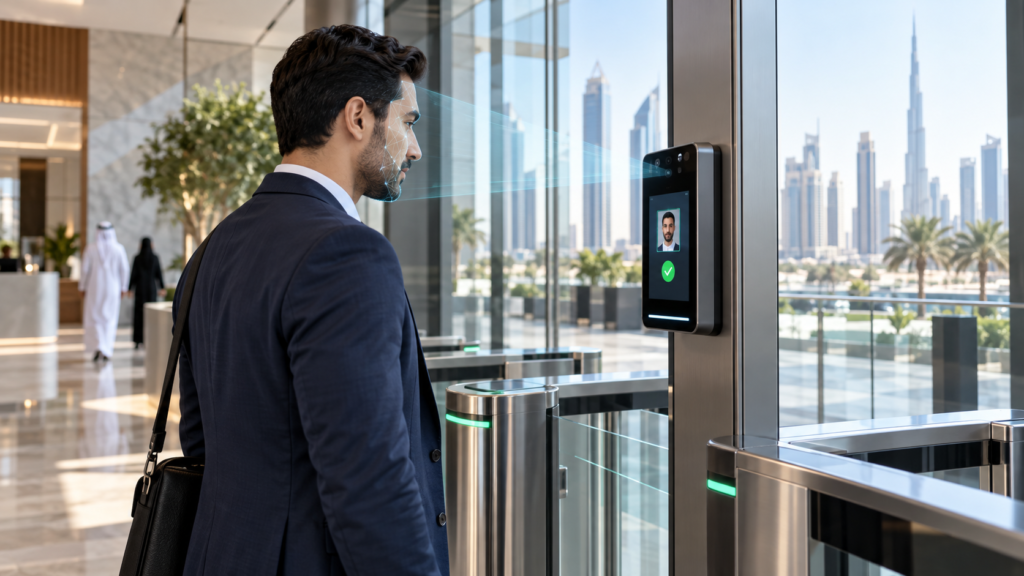
- The SpeedFace Ecosystem represents Fixed Perimeter Security. It is a Linux-native, wall-mounted, or turnstile-integrated terminal engineered for high-throughput access control and structural security at static physical entry points.
The Structural Differences between Speedface Series and Horus Series
Instead of looking at minor software settings, the architectural divergence between Horus and SpeedFace clusters around four high-level pillars.
1. Operating System Architecture (Android 10 vs. Embedded Linux)
Instead of looking at minor software settings, the architectural divergence between Horus and SpeedFace clusters around four high-level pillars.
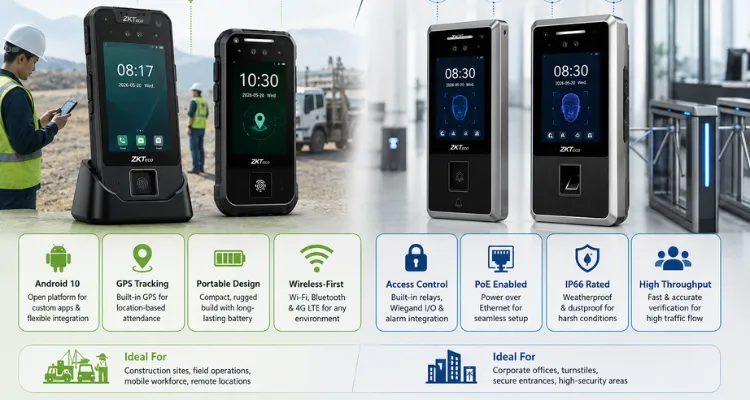
- Horus (Android 10 Platform): Operating on an open Android foundation (such as the Octa-core processor powered Horus E2), this series functions like an enterprise smart device. It allows direct integration of third-party Android apps, custom workflow screens, and complex logic apps built directly on the terminal.
- SpeedFace (Embedded Linux): Operating on a specialized, lean Linux firmware (like the Quad-Core SpeedFace M4), these devices are built for maximum uptime, rigid security, and single-purpose execution. They are highly resistant to local operating system exploitation and execute biometric verification loops in fractions of a second.
2. Network Infrastructure & Edge Autonomy
How these devices communicate defines where they can be physically deployed:
- Horus (Wireless-First & Location Aware): Engineered to operate far away from an IT closet. The series relies on dual-frequency Wi-Fi, Bluetooth, and cellular 4G LTE bands. Crucially, models like the rugged Horus H1 include a dedicated GPS chip, binding every time stamp to precise geospatial coordinates.
- SpeedFace (Wired-First & Local Area Reliant): Engineered to hook into your physical building architecture. While Wi-Fi is available as an option, the primary connection is via native RJ45 TCP/IP Ethernet. The latest industrial iterations, such as the SpeedFace M4, feature native Power over Ethernet (PoE), drawing operational current and network data through a single physical drop.
3. Physical Access Control Engineering
The physical electrical relay capabilities separate their core operational purposes:
- Horus (Peripheral Access): It is primarily a cloud-based Time & Attendance engine. While it can act as a basic door trigger via external modular expanders (like the ZKTeco DM10 sub-module), it lacks complex on-board access control wiring.
- SpeedFace (Heavy Access Control Interfacing): This is a true perimeter gatekeeper. The physical chassis is packed with native relays to connect directly to 3rd-party electric locks, heavy magnetic strikes, emergency exit buttons, door sensors, external alarms, and legacy Wiegand Input/Output infrastructure.
4. Form Factor & Environmental Hardening
The physical shell dictates the deployment topology:
- Horus (Pocketable or Desktop-Ready): Compact devices roughly the size of a standard smartphone. They include desktop docks, portable handle mounts, and removable, rechargeable lithium backup batteries designed for deployment in fields, mobile trucks, or pop-up desks.
- SpeedFace (Industrial Structural Mounts): Large, solid wall-mounted enclosures or custom pillars designed to drop seamlessly into turnstiles. Heavy-duty updates like the SpeedFace M4 and M6 feature solid metallic silver casings and carry an IP66 ingress protection rating, making them completely immune to heavy rainwater spray and industrial dust.
Technical Comparison for ZKTeco Horus Series Vs ZKTeco SpeedFace Series
Technical Comparison for ZKTeco Horus Series Vs ZKTeco SpeedFace Series, you should consider the following details:
| Architectural Feature | ZKTeco Horus Series (E2 / H1) | ZKTeco SpeedFace Series (V4L Pro / M4 / V5L) |
|---|---|---|
| Primary OS Environment | Android 10.0 | Embedded Linux |
| Core Processing Power | Octa-core @ 2.0 GHz | Quad-core (A53/A55 Architecture) |
| Primary Network Loop | 4G LTE Cellular Dual-Band Wi-Fi | TCP/IP Wired Ethernet Native PoE |
| Geospatial Tracking | Integrated Hardware GPS Chip | N/A (Static Network Bound) |
| Physical Lock Interfacing | Optional External DM10 Module | Native Onboard Relays Wiegand I/O Terminals |
| Enclosure Rating | Up to IP65 Model Dependent | Up to IP66 Heavy Industrial Metal Housing |
| Ecosystem Deployment |
Construction Sites Mobile Fleets Distributed Care |
Turnstiles Corporate Lobbies Secure Perimeters |
Next-Generation Algorithmic & AI Advancements
If you are upgrading from an older generation system, ZKTeco has rolled out platform-wide AI adjustments across both lines:
- Intellectualized Engineering Face Algorithms: The newest SpeedFace hardware revisions feature specialized neural processors. This allows them to run advanced deep-learning facial authentication models locally, reducing match times to under one second even with tens of thousands of active users.
- Multi-Modal Palm Vein Integration: Models like the updated SpeedPalm-V5L use a dual-modal strategy. The camera sensor cross-references the external physical palm print with the sub-dermal blood-flow pattern of your palm veins. If an employee’s hand is dirty or scarred, the software dynamically recalculates biometric weights to ensure accurate tracking.
- Starlight Binocular Liveness AI: Upgraded 2MP WDR binocular lenses combine near-infrared sensors with low-light color lenses. The AI detects skin-grain dynamics to actively ignore high-definition video rollbacks, paper prints, or 3D silicone mask spoofing attempts.
Central Software & Cloud Ecosystem Compatibility
Both device lines have shifted toward unified server architectures, abandoning isolated local data storage:
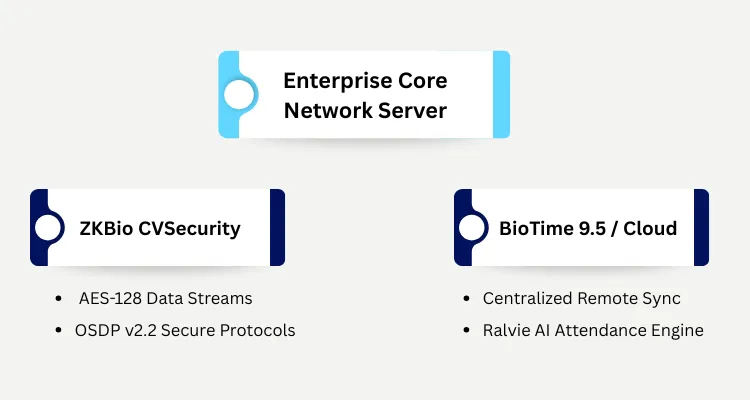
- Access Control Management: Both series hook directly into platforms like ZKBio CVSecurity or CVAccess. They leverage end-to-end AES-128 encryption and conform to secure OSDP v2.2 protocols to keep data pipelines protected from network tampering.
- Time Attendance Management: Real-time logging connects with platforms like BioTime 9.5 and BioTime Cloud. This includes Ralvie, a built-in AI productivity tool used for smart employee shift scheduling, automated branch reporting, and pattern anomaly tracking.
Final Decision Framework: Which Line Fits Your Operation?
Choosing between these systems comes down to a clear infrastructure question:
- Choose the Horus Series if: You manage decentralized operations without fixed IT networks (such as oil and gas sites, construction zones, or transit fleets), require remote location verification via GPS, or need a portable device that can adapt to custom application development.
- Choose the SpeedFace Series if: You are securing a physical corporate office, educational facility, or factory floor where devices must mount directly onto turnstiles or doors, tie into fire alarms, draw power over Ethernet cables, and manage high-volume, rapid building throughput.
If you are sourcing hardware for a project, you can compare local stock availability for corporate models via eTOP