
Which ID Card Printer Should You Buy in 2026?
Matica MC660 vs XID8300 & XID8600:
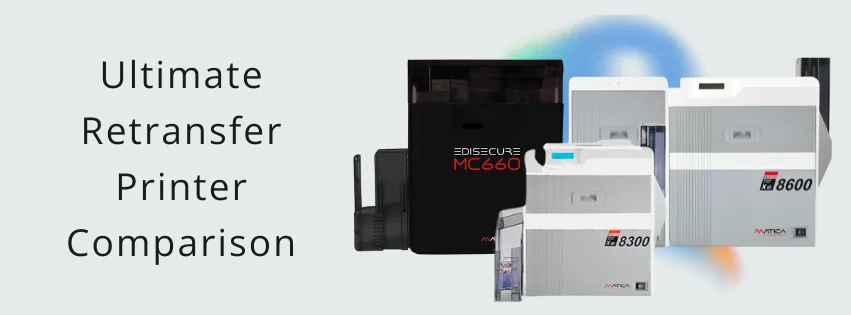
Choosing the right high‑security card printer is a long‑term investment decision, especially when you need sharp 600 dpi printing, reliable security features, and predictable consumables costs. In this article, we compare the Matica MC660 with the Matica XID8300 and XID8600 to help you identify and procure the latest and most suitable model for your needs.
Generations and launch timeline
Matica’s XID‑series and MC‑series belong to two different product generations aimed at high‑quality retransfer card printing.
-
XID8300 is part of the older XID “Series 8” platform, widely adopted from the early 2010s for enterprise and government ID programs.
-
XID8600 is the higher‑resolution 600 dpi member of the same XID family, designed for ultra‑sharp, secure card personalisation and microtext printing.
-
MC660 is Matica’s newer MC‑series 600 dpi retransfer platform, launched later as the next generation of high‑end printing, with updated electronics, firmware and a refreshed consumables ecosystem.
From a lifecycle point of view, MC660 sits at the top as the most recent platform, followed by the XID8600 and then the XID8300.
DPI, print quality and security capability
When you evaluate printers for secure ID, access control or financial cards, native resolution and how it translates into visual security are critical.
-
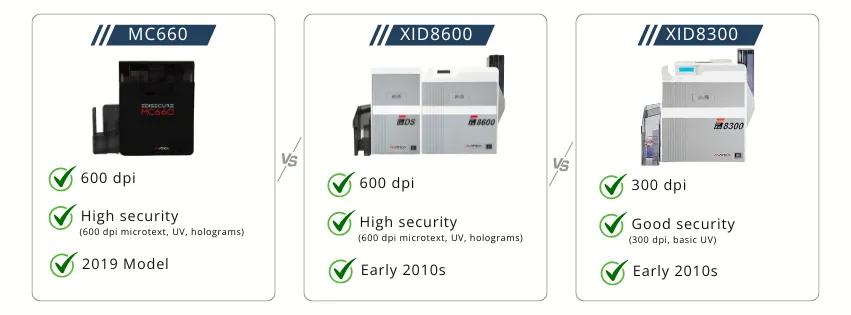
XID8300 offers 300 dpi retransfer printing. This is sufficient for clear photos and text, but more limited for fine microprinting and complex security artwork compared to 600 dpi engines.
-
XID8600 delivers 600 dpi resolution, allowing highly detailed elements such as microtext, intricate guilloches, and crisp 2D barcodes suitable for high‑security applications.
-
MC660 also prints at 600 dpi, but on a more modern platform. It supports very fine graphics, microtext and sharp barcodes, and is positioned for secure government, banking and corporate ID environments.
If “latest in terms of dpi and security” is your priority, you can largely consider XID8600 and MC660 in the same high‑resolution class, with MC660 offering the newer hardware base.
Consumables yield and running cost
Beyond the purchase price, consumables yield has a direct impact on your total cost of ownership and operational workflow.
-
XID8300 and XID8600 typically use high‑yield YMCK ribbons and retransfer films designed for around 1,000 single‑sided cards per roll in many standard configurations. This means fewer changeovers and attractive cost per card in larger deployments.
-
MC660, in many commonly listed supply configurations, is paired with YMCK ribbons and retransfer films around the 500‑card mark per roll, although some channels also mention higher‑yield options up to 1,000 cards depending on the exact ribbon and film type.
In practice, this means the older XID platform often wins on pure yield per roll, while the MC660 focuses more on platform modernity and flexibility. When you scope your project, it is important to confirm the exact ribbon and film part numbers and their stated yield with your distributor, as this directly affects your cost model.
Side‑by‑side feature table
The table below summarizes the key differences between the three models so you can quickly see which aligns best with your priorities.
| Feature | Matica XID8300 | Matica XID8600 | Matica MC660 |
|---|---|---|---|
| Launch generation | Older XID Series 8, 300 dpi era. | XID Series 8 high-resolution 600 dpi era. | New MC retransfer series, launched June 2019. |
| Native print resolution | 300 dpi retransfer. | 600 dpi retransfer. | 600 dpi retransfer. |
| Visual security capability | Good photo quality, UV ribbon options; limited microtext due to 300 dpi. | Very fine detail, microtext, and complex security artwork at 600 dpi. | 600 dpi with microtext and high-precision barcodes; designed for secure ID, supports advanced options like custom holograms and MSPI. |
| Typical YMCK ribbon yield | Approximately 1000 single-sided cards per YMCK ribbon. | Approximately 1000 single-sided cards per YMCK ribbon (same family ribbons). | Standard YMCK ribbon commonly 500 prints per roll; some options up to 1000 cards. |
| Retransfer film yield | Typically 1000 cards per film for Series 8 retransfer printers. | Same high-yield 1000-card films for XID retransfer. | Commonly specified at 500-card retransfer films in many supply catalogs. |
| Ecosystem age | Most mature and oldest; very widely deployed. | Mature ecosystem, newer than XID8300 within the XID line. | Newest electronics, firmware stack, and MC-series consumable line. |
Which model should you procure?
If your main goal is to procure the latest model with high‑end DPI and security potential, the MC660 is the clear choice: it offers 600 dpi resolution like the XID8600 but on a newer architecture with a modern consumables and options ecosystem.
If your priority leans more towards maximum consumables yield and lowest ongoing cost, an XID‑series device still makes sense, with the XID8600 giving you both 600 dpi and typically higher‑yield ribbons and films than standard MC660 configurations.
For most new deployments that need strong visual security, future‑proofing and 600 dpi quality, you’ll usually shortlist MC660 vs XID8600, then decide based on:
-
Whether you value newest‑generation hardware (favour MC660).
-
Whether you prioritise consumables yield and cost per card (often favour XID8600).
-
Any ecosystem constraints such as existing XID ribbons/films already in your organisation.
If you share your projected monthly card volume and whether you need advanced security features (microtext, UV, holographic overlays), the choice can be narrowed even further and mapped directly to expected cost per card.