
This article explains the four main types of access control systems — DAC, MAC, RBAC, and ABAC — alongside physical access methods and deployment strategies that UAE organisations use to secure facilities and data. By the end, you will have a clear framework for choosing the right access control model for your industry, building type, and compliance requirements.
Key Takeaways
- Four Core Models: Access control relies on DAC, MAC, RBAC, and ABAC to define and enforce access permissions.
- Physical Credentials: Facilities protect entry points using proximity cards, PIN codes, and biometrics (fingerprints and facial recognition).
- UAE Compliance: Hardware deployed in the UAE must comply with the Emirates Conformity Assessment Scheme (ECAS), obtain a Certificate of Conformity, and meet the UAE Federal Law on Product Safety.
- Centralised & Multi-Factor Security: Combining multi-factor credentials and centralised server management eliminates single points of failure and inconsistent site policies.
What Are Access Control Systems and Why Do They Matter?
Access control systems are security frameworks that use identification, authentication, and authorisation to determine who may enter a physical space, access a digital resource, or perform a specific action. They apply equally to office doors, server rooms, file systems, and cloud applications. For UAE businesses, government entities, and institutions, implementing the correct access control model is a foundational requirement for both operational security and regulatory compliance.
Without a structured access control approach, organisations face risks including:
- Unauthorised entry
- Data breaches
- Insider threats
- Inability to produce audit logs during an incident investigation
Choosing the right system type directly affects how efficiently permissions are managed, how quickly breaches are detected, and whether the organisation can demonstrate compliance to auditors or regulators.
What Are the Four Main Types of Access Control Systems?
1. Discretionary Access Control (DAC): Flexible Permission Management for Business Owners
Discretionary Access Control (DAC) allows the owner of a resource — whether a file, room, or system — to decide who may access it and to delegate those permissions to others. This model gives department heads and asset owners direct control without requiring central IT or security approval for every change.
DAC is well suited to UAE businesses that operate with distributed ownership of resources, such as a department managing its own document repositories or a facility manager controlling access to specific storage areas. The flexibility it provides comes with a trade-off: if a resource owner makes a poor decision or an account is compromised, permissions can spread beyond intended boundaries. DAC works best when combined with corporate policy guardrails and regular permission audits.
2. Mandatory Access Control (MAC): Government-Grade Security Classification
Mandatory Access Control (MAC) enforces access based on centrally defined security classifications and user clearances, removing the discretion of individual resource owners entirely. A central authority assigns security labels to every resource and every user, and the system automatically permits or denies access based on whether the user’s clearance level matches the resource’s classification.
MAC is the standard approach for UAE government agencies, defence institutions, and critical infrastructure operators that must meet strict national security and data protection requirements. Because access decisions are made by the system rather than by individuals, MAC eliminates the risk of accidental over-permissioning and provides a highly auditable access record. Organisations operating under UAE federal data protection and national security frameworks will find MAC aligned with their compliance obligations.
3. Role-Based Access Control (RBAC): The Enterprise Standard for UAE Organisations
Role-Based Access Control (RBAC) assigns permissions according to predefined job roles, so a user inherits access rights through their position rather than through individual negotiation. When an employee joins, changes role, or leaves, their access profile updates with their role — eliminating the need to manage permissions one user at a time.
RBAC is the most widely implemented model in commercial and enterprise environments globally, and it is the practical default for UAE businesses in banking, healthcare, real estate, and logistics. It directly supports compliance with internal controls and external audit requirements because permissions are tied to documented organisational roles rather than individual preferences. For UAE enterprises managing large workforces across multiple sites, RBAC significantly reduces the administrative burden of onboarding and offboarding while minimising permission errors.
4. Attribute-Based Access Control (ABAC): Conditional Policies for Modern Workplaces
Attribute-Based Access Control (ABAC) evaluates multiple attributes simultaneously — including user role, time of day, location, device type, and resource sensitivity — before granting or denying access. This makes ABAC the most granular and flexible of the four main access control models.
UAE organisations adopting cloud infrastructure, hybrid working, or remote access scenarios benefit directly from ABAC because it allows policies such as: permit access to the financial system only from registered devices, only during business hours, only from within the UAE. This level of contextual control is not achievable with RBAC or DAC alone. ABAC is increasingly relevant for UAE businesses that must balance operational flexibility with protection of sensitive data across distributed environments.
Comparison of Access Control Models
Nitgen fingerprint readers are designed for on-premise enterprise environments, connecting via standard LAN/IP networks, with optional WiFi connectivity available on certain models. This setup allows security administrators to monitor and manage multiple terminals across a facility or an entire campus from a single, centralized point.
This networked architecture is perfect for multi-site organizations like corporate campuses, industrial zones, or government complexes in Riyadh, Jeddah, and across the Kingdom. It integrates seamlessly into existing IT infrastructure, providing real-time event monitoring without depending on a cloud connection.
| Access Control Model | Primary Mechanism | Best Suited For | Key Advantage |
|---|---|---|---|
| Discretionary Access Control (DAC) | Resource owners grant, modify and revoke permissions for users and groups. | Shared office environments, departmental file servers, collaboration platforms and local resource management. | Highly flexible access management that allows individual resource owners to control permissions independently. |
| Mandatory Access Control (MAC) | Access decisions are enforced using centralized security classifications, labels and user clearances. | Government agencies, military organizations, defence projects, financial institutions and critical infrastructure. | Maximum security with strict policy enforcement, complete auditability and protection against unauthorized access. |
| Role-Based Access Control (RBAC) | Permissions are assigned according to predefined organizational roles and job responsibilities. | Banking, healthcare, education, logistics, manufacturing and enterprise organizations. | Simplifies user provisioning, onboarding, offboarding and permission management while reducing administrative effort. |
| Attribute-Based Access Control (ABAC) | Access is determined dynamically using attributes such as user role, location, device, department and time. | Cloud environments, hybrid workplaces, zero-trust security architectures and enterprise SaaS platforms. | Provides highly granular, context-aware access policies for enhanced security, compliance and operational flexibility. |
Physical Access Methods: Cards, PINs, and Biometrics
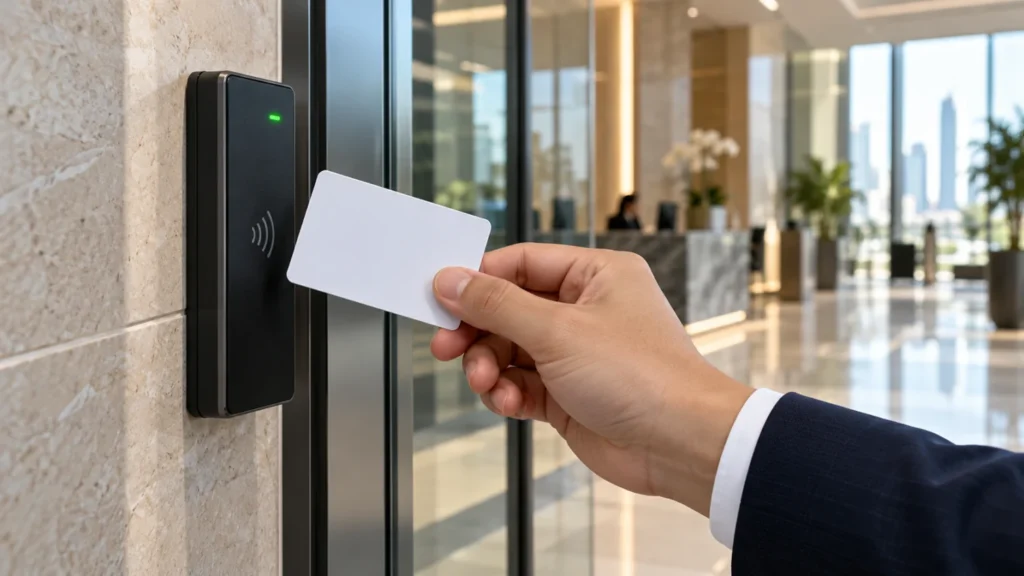
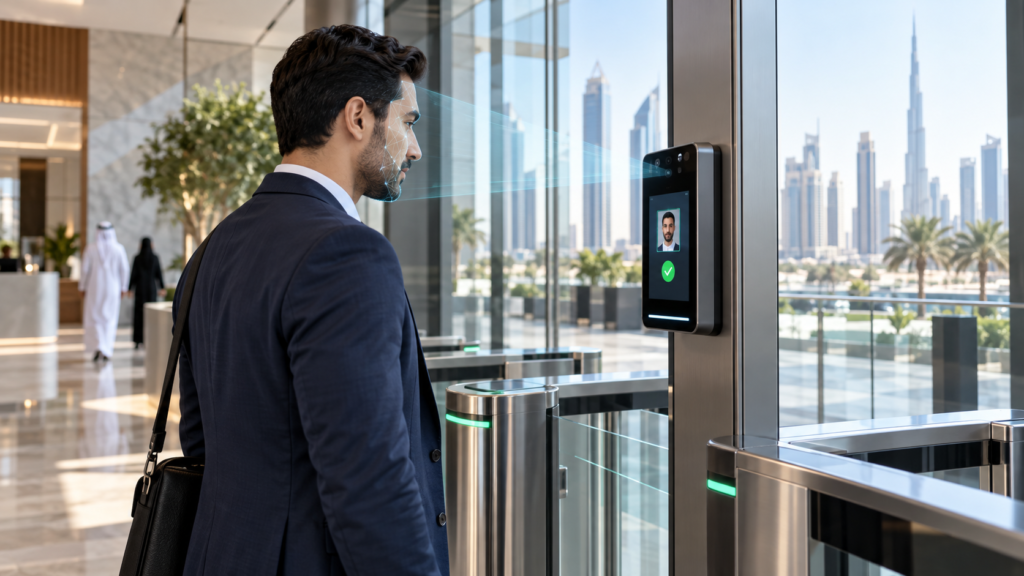
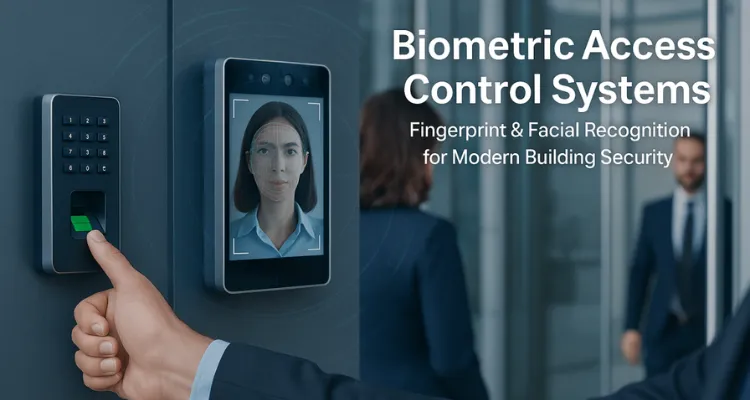
Physical access control systems use credentials to identify and authenticate individuals at entry points including doors, gates, and turnstiles. The three primary credential types used in UAE facilities are:
- Proximity Cards and Badges: Convenient for entry, but can be lost or cloned.
- PIN Codes: Low-cost, but can be shared or observed.
- Biometric Identifiers: Fingerprints and facial recognition. Highly accurate and non-transferable.
Each credential type carries a different security profile. Biometric identifiers are the preferred option for high-security UAE facilities such as data centres, healthcare records rooms, and government offices. The choice of credential should reflect the sensitivity of the space being protected and the operational flow of the people using it.
Centralized and Multi-Factor Access Control for Stronger Protection
Centralised access control systems connect all readers, panels, and doors to a central server or controller that enforces policies and records every access event across an entire site or estate. This means a policy change made once at the server propagates immediately to every door — eliminating the inconsistencies that arise when access permissions are managed device by device.
For UAE businesses operating multiple locations — offices in Dubai, warehouses in Jebel Ali, and branches in Abu Dhabi — centralised systems provide unified control, simplified investigations, and consistent policy enforcement from a single management interface.
Multi-factor access control adds a second or third credential requirement, combining for example a card with a PIN or a card with a fingerprint scan. This combination dramatically reduces the risk of a lost card or a shared PIN enabling unauthorised entry, and it is increasingly expected in UAE facilities handling high-value assets or sensitive personal data.
Who Should Implement Access Control Systems in the UAE?
Access control systems are relevant to any UAE organisation that needs to restrict, monitor, or audit entry to physical or digital resources. The correct model depends on the organisation’s size, sector, regulatory environment, and security risk profile.
These are the primary buyer profiles that benefit most from structured access control in the UAE:
- Government and public sector entities in Abu Dhabi and Dubai: Requiring MAC-level security classification and full audit trail compliance.
- Banks and financial institutions: Needing RBAC to align permissions with organisational hierarchy and support regulatory audits.
- Healthcare facilities: Protecting patient records, pharmaceuticals, and restricted clinical areas with biometric and centralised systems.
- Schools and universities: Managing student, staff, and visitor access across multiple buildings and time-controlled zones.
- Logistics and warehousing operators in Jebel Ali and Dubai South: Controlling access to high-value cargo areas with card and PIN credentials.
- Corporate offices: Adopting ABAC for hybrid work policies that restrict system access by location, time, and device.
Frequently Asked Questions
What are the four main types of access control systems?
The four main types of access control systems are Discretionary Access Control (DAC), Mandatory Access Control (MAC), Role-Based Access Control (RBAC), and Attribute-Based Access Control (ABAC). Each model uses a different logic for assigning and enforcing permissions — from owner-defined rules in DAC to policy-driven conditional access in ABAC. The right choice depends on the organisation’s size, security requirements, and compliance obligations.
Which type of access control system is best for UAE government entities?
Mandatory Access Control (MAC) is the most appropriate access control model for UAE government and defence entities because it enforces access based on centrally defined security classifications and user clearances, with no discretion given to individual resource owners. This model eliminates the risk of accidental over-permissioning and produces a fully auditable access record aligned with national security and data protection requirements.
What is RBAC and why do UAE enterprises use it?
Role-Based Access Control (RBAC) is an access control model that assigns permissions according to an employee’s job role rather than as individual grants. UAE enterprises use RBAC because it simplifies onboarding and offboarding, reduces permission errors, and directly supports compliance with internal audit controls and external regulatory requirements. It is the most widely implemented access control model in commercial environments.
Do access control systems in the UAE require regulatory certification?
Yes. Electronic access control hardware sold in the UAE must comply with the Emirates Conformity Assessment Scheme (ECAS) and obtain a Certificate of Conformity before it can be legally imported and traded. The UAE Federal Law on Product Safety also requires that products meet approved technical standards, and Arabic labelling is mandatory for regulated hardware entering the market.
What physical credentials are used in access control systems?
Access control systems use three primary physical credential types: proximity cards and badges, PIN codes, and biometric identifiers including fingerprints and facial recognition. Biometrics offer the highest security because they cannot be transferred or shared, making them the preferred choice for sensitive UAE facilities such as data centres, government buildings, and healthcare environments.
What is multi-factor access control and when should a UAE business use it?
Multi-factor access control requires users to present two or more independent credentials — for example, a proximity card combined with a fingerprint scan or a PIN code. UAE businesses handling high-value assets, sensitive personal data, or restricted facilities should implement multi-factor access control to significantly reduce the risk of a compromised or shared credential enabling unauthorised entry.
Where can I source compliant access control systems for UAE facilities?
Access control systems for UAE facilities should be sourced from suppliers who can confirm ECAS certification and provide the required Certificate of Conformity documentation. Pricing, availability, and compliance documentation for access control systems in the UAE are available on request through eTOP, along with expert guidance on selecting the right model for your facility type.